

On Being Dead
Inanna Slapped

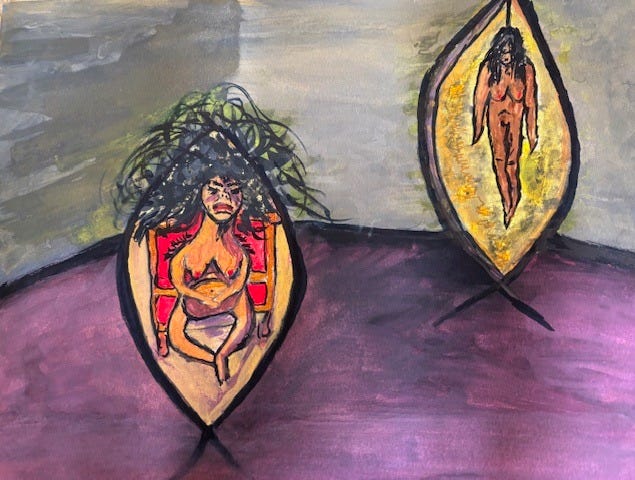
In ancient Sumerian and Mesopotamian mythology, Inanna, Queen of Heaven and Earth, descends through the seven gates to the underworld in an archetypal pattern of death and rebirth—a pattern I believe our culture is experiencing now. This post is part ten of a multi-part series, though each part is a separate subject and stands alone. All previous posts are available at Modern Mythology.
The Annuna, the judges of the underworld, surrounded her.
They passed judgment against her.
Then Ereshkigal fastened on Innanna the eye of death.
She spoke against her the word of wrath.
She uttered against her the cry of guilt.
She struck her.
Inanna turned into a corpse.
A piece of rotting meat,
And was hung on a hook on the wall.
Wolkstein and Kramer
Erishkigal, the enraged, dark feminine, is pregnant when she rises from her throne to slap the Queen of Heaven and Earth, her sister. Erishkigal’s eternal function is to receive the dead as they pass into her realm, nurture them in her black womb, and give birth to the whole world anew, cyclically. When Inanna enters, she is beginning her travail. She is in no mood. The Annuna, representatives of all the people, species, and habitats who have suffered from our greed and arrogance, step forward to judge. Who has a more legitimate right to judge than those we have harmed? They, more than anyone, understand the suffering our arrogance has caused. Guilty! They proclaim.
In the early years of our cultural decline, I was amazed when people exclaimed, "We are better than this!" That seems so naive now. All the broken norms, the corruption, the racism and misogyny, the canibalistic capitalism that consumes the lives of its workers, the normalizing of cruelty and hate, the way lies, fear, and greed so easily manipulate us - this is what we are: a knot of terrified self-interest. This is our collective shadow.
And remember, Inanna is guilty. She has come to attend the funeral rites for Guglana, Ereshkigal’s husband, blithely overlooking the fact that she is personally responsible for his death. Thoughts and prayers, people. Thoughts and prayers.
There’s something timeless about this archetypal image - the death and rebirth god - present in so many cultures: Inanna, Odin, Osiris, Tammuz, Adonis, Attis, Dionysus, and an earlier form of Dionysus called Zagreus, and Jesus, of course, to name a few. When they die, they travel to an underworld, a dark womb, a cave with a rock rolled across the entrance, or a burial mound. They are dead three days, or nine, or an unspecified time.
We return to the womb of the earth, our mother. Many ancient cultures positioned their dead within the Earth’s womb in the fetal position to await rebirth. It’s a potent image. Our death and rebirth myths delineate a powerful archetype, one of the ways we evolve and grow as individuals and cultures. It’s a pattern that repeats. The child must die so the adolescent can be born; the adolescent must give way for the adult, and so on.
Our culture has a lot to answer for, not the least being our elevation of a wrathful, patriarchal god of war, a fear-of-death god, whose representatives are now saying we can’t afford compassion.
Our culture has a Yahweh complex, the toxic masculine, and our leaders are emulating that. This god’s myth teaches that our world is terrifying, terrible, fallen - even evil. There is no need to respect it. We should focus on the afterlife - getting to heaven to be with Him. In this myth, an omnipotent God has to send us a savior from the world he created. But when we die, he will likely punish us with eternal damnation - a relatively new concept, mythically speaking.
So we are god-fearing, god-terrified.
His hatred of the feminine is such that we all carry original sin simply because we are born through a woman. We think we need strong men in charge of enormous armies, even though they only use them to create endless wars. Then, they tell us we can do nothing about how the world is except protect ourselves. Our God set it in stone. In a world of abundance, we live in scarcity. So, we think life is a competition won by collecting the most money and power. Compassion is a luxury we can’t afford. Even our wealthiest can never have enough. There is no such thing as enough.
The United States, as we have known her, is smashed. The pieces cannot be put back together. We cannot return to the way we were. The Annuna, the underworld judges, pronounce us guilty - and we are. There is only one thing left. The slap, when it comes, will stop us cold. I don’t know what form that will take, but it will shock us all. Then, the furious dark feminine will hang our corpse on a meat hook to rot. We will be dead.
How do you breathe after such a loss?
You sink to the bottom of the ocean with no desire to surface. Your lungs draw in water and release it. You think: How am I breathing? There is no desire for anything. No desire at all. It’s mercifully quiet down there. Even your oldest companion, that voice that comments, measures, and evaluates- the you that you think you are- is dead.
You look out through eyes and blink. The worst thing has happened. You have died. And yet you are still awake. It is not possible, but it is true. How am I still here? There is no one to ask. There is nothing to do but hang on the wall and be dead.
When I was a little girl, I had my first BIG dream - the kind that is so vivid it can’t be forgotten - a dream that sets the pattern. I walked along the bottom of the ocean, under water so deep and heavy that only a glint of light could be seen way up on the surface. I examined the fish, rocks, and plants, almost out of breath. The kelp swayed, anchored to rocks. It was too late. I’d made a life-ending mistake. Lungs burned - ached for air. Blood cried out for oxygen. Lungs insisted. My body gasped. Water poured in. I saw it flooding the hollow branches. I exhaled, and water swirled out. I was amazed. Breathing water was effortless, a liberation. I never had to surface again.
Death is a friend. But our myths tell us to fear her.
It occurs to me now, 30 years later, that the vision that killed me, the one I wrote about in my last post, was a waking dream of being about the same age. The symmetry of it stuns me. Life and death united. The forces at work, both personally and collectively, are vast. There is more at play here than we think.
I can’t remember how long I was dead. It must have been a long time. But I don’t know. How long is three days in the underworld? Like all myths, it’s a metaphor. Your results may vary. Our collective results certainly will.

I’d love to hear your thoughts. Please leave a comment in the box below.
I can so easily relate to this personally (the super dysfunctional childhood), politically (as you are really hitting the current “situation” right on the head and I’m going to restack some of your great lines) and Gnostic-ly as I’ve been attending Gnostic services online and reading up on all the related myths and Jung and Campbell (Joey’s an expert) and I started doing these services because of my concerns about what we as a civilization are going through (and I feel the same way you do that we’re on some precipice). I’m looking forward to going back through your archive (no matter how long it takes for me to find the time in my chaotic life), and commenting on those!
Wonderful to find another myth worker here. What powerful parallels you draw between the mythic and the modern moment.