

Surrendering Our Worldview
Inanna’s Sixth Gate

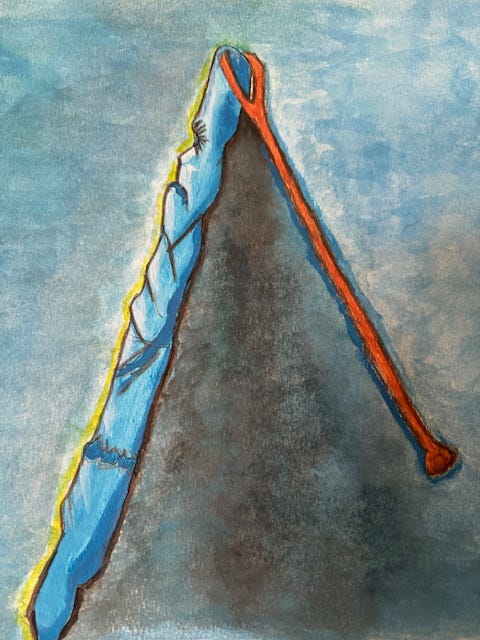
In ancient Sumerian and Mesopotamian mythology, Inanna, Queen of Heaven and Earth, descends through the seven gates to the Underworld in an archetypal pattern of death and rebirth—a pattern I believe our culture is experiencing now. This post is part eight of a multi-part series, though each part is a separate subject and stands alone. All previous posts are available at Modern Mythology.
When she entered the sixth gate,
From her hand the lapis measuring rod and line was removed.
Wolkstein and Kramer
In the ancient world, architects, surveyors, and builders used rods to measure the world. Since Inanna is Queen of Heaven and Earth, her rod is made of lapis, a precious stone. With it, she can measure, calculate, compare, and make decisions based on her measurements. Our internalized rod constantly measures our world against who we are in it to see how we measure up. The measuring rod represents our worldview.
When I passed through the sixth gate, I lived with my re-mother, Phyllis Benbow, providing hospice care for bedridden elders in their home. Jim had cancer, and Jean had advanced Alzheimer’s. Though I was in my mid-thirties, I lived like a teenager watching Phyllis as she modeled a compassionate way of being in the world. I’d never imagined anyone like her could exist. How did she do it? She had no safety net, no money, no home of her own. If I’d been in her situation, I’d have been terrified. Then I realized I was in her situation, except I wasn’t old.
Jean, who used to be a dancer, swept her arms and legs in her bed in a parody of dancing. She spoke to people only she could see. When Jean had guests, Phyllis sat by her bed, head cocked, listening, smiling, and nodding to these conversations. If Jean laughed in delight at what her friends said, Phyllis laughed along - and clapped.
But Jean began having bad days. She flailed and screamed, “No! You bastard!” Then she’d curl into the fetal position and cover her head with her arms and whimper. Phyllis put her hands on Jean’s back, smoothed her hair, and crooned, “You are not alone. We won’t let anyone hurt you. I promise.”
While that was happening, Jim prayed softly, tears streaming from the corners of his eyes into his pillow. “Forgive me Lord, Forgive me.”
I wavered in the doorway, my lungs deflated, and thought, What have you done? Then I thought, Is there no escape?
Over the previous year, I’d tried everything. I’d sworn off relationships with men. Clearly, I wasn’t attracted to the good ones. I had a female roommate until her angry ex-husband showed up rather dramatically. So, I tried living alone only to find violence tearing apart the neighbor’s house and spilling into my yard. Was every woman in America abused by her partner, or was it just me? And now, even with Phyllis, the most gentle soul imaginable, I lived in a house where a wife screamed for protection from a husband crushed by remorse.
How does this keep happening?
I looked around me. The house seemed frozen in the 1970s, right up to the orange shag carpets - the decade I’d been a teen when the violence in my home was at its worst. Jim was skeletal now, but he had been a large man, over six feet tall. He dwarfed tiny Jean in photos spread around the bedroom.
Jean’s episodes escalated, coming more often and with more terror. Jim slipped into a semi-conscious state, praying around the clock to die. “Please, Lord. Take me. Please Lord. Take me.” But he was terrified of death, and couldn’t let go. He didn’t eat, never opened his eyes. He didn’t respond to questions, sleep or stop praying. Even Phyllis couldn’t calm him.
The prayer-without-ceasing repeated day and night for 48 hours. Phyllis, in her late 70s, was exhausted. I took the elder monitor that night to give her some rest. Jim never stopped praying. In the wee hours, I gave up trying to sleep and stood bedside, looking down at Jim. In classes to become a spiritual practitioner, I had been taught how to pray at a New Age church. I asked gently, “Do you want me to pray with you?”
Without opening his eyes he said, “Oh yes, Dear. Please.” I was stunned by the lucid response, but I wanted to emulate Phyllis.
He twitched his bony hand toward me and I clasped it, dry and papery. What should I pray for? Forgiveness, I decided. I closed my eyes. Armed with a five-step formula, I began, “There is only one love, and that love is the love of God.” Love, it seemed, had been waiting for an opening. It overwhelmed my pitiful formula.
It flowed in and through and around us, bypassing me and all I thought I knew. Jim sighed, and holding hands, we slipped between the worlds. A river of words burbled through my throat. This prayer wasn’t about words - but sound. Like ripples at the shore, it washed us. Jim cried, and so did I. In the silence between words, the prayer sang. The dust motes in the air seemed to sparkle. Time went on and on. We were in love. Had this man abused his wife? It didn’t matter. Was my father included in the love? Yes, I felt sure he was there.
Finally, Jim’s breath drew softly in and out. He was asleep. I put Jim’s hand back on his chest, and went back to bed.
I rose early, feeling exuberant, and went hiking in the hills. I tried to remember what I said - something about letting go, something about trust, plenty about love. When I returned, Phyllis told me that Jim had died.
That was a shock, though it shouldn’t have been. Fearing I had killed him, I was terrified to tell Phyllis of my part. But, I told her about the prayer. “What was that?” I asked her. She didn’t answer, but I desperately needed her to. I felt betrayed. All that gooey New Age religion was as mistaken as Jim’s rigid Christianity. The world they reacted to didn’t exist. The person I thought I was didn’t exist either. Both our cultures were wrong about reality; perhaps every culture was.
If I had been born in 1650s New England rather than 1950s New England, I would have a different measuring rod—a different Christian mythology, one even more overtly dedicated to managing the fear of death, which I would undoubtedly have believed. Not believing could get a girl killed. Of course, the village shows up to the witch hanging because we are fascinated: What happens when we die?
Duality creates a spectrum between opposite poles. There is no sanity without craziness, no health without disease, no up without down, no political left without the right - no life without death. The measuring rod is the spectrum along which the landscape is surveyed. How bad is it? We measure. What does this mean? We measure. Who am I? We measure. When Rumi said: “Out beyond ideas of rightdoing and wrongdoing, there is a field,” he pointed to a world beyond duality. To get there, we either have to die or surrender our fear of death.
Recently one of our political leaders argued that compassion is the weakness of Western culture, and a podcast audience of millions nodded their heads. The wealthiest man in the world claims that we can’t afford compassion. That worldview comes directly from the terror of death, which has always been running our government. In this time of apocalypse (a slow revealing we have been in for decades already) it will become so clear we can no longer deny it.
At the sixth gate, we will be forced to admit (welcome) our terror of death and see what it causes. We will realize that every institution - religious, political, legal, educational, financial, familial - is crafted from this raw material. Death will breach our defenses. It already has. People have already died.
As a culture, we will sense where this descent is going as we approach this penultimate gate. Terror rises to a fever pitch, humming like angry bees. We are going to die. There is no escaping it. We slap our hands over our ears, but to no avail. The sound is coming from inside.
Dear Susan, This is such a powerful story. I felt alive, captivated by the intensity, the love, the shock of the death. So well written and real thank you so much.
I love the Rumi poem, there is a field out beyond right and wrong … I meet you there 🌹💕