

Why I Write Feminist Historical Fiction
In answer to the male default bias, though I didn’t know it was called that at the time

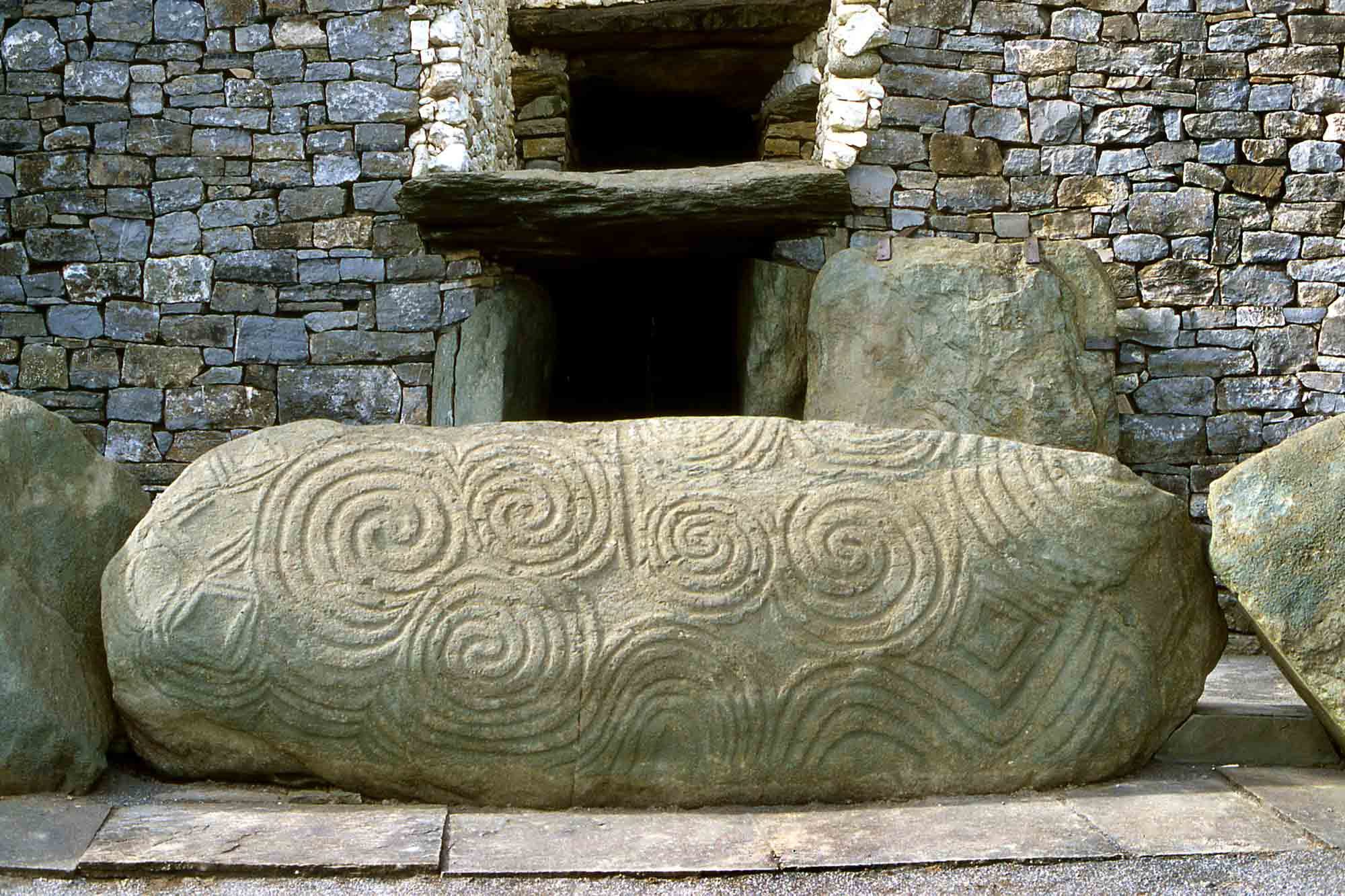
About 35 years ago, I entered the womb at Newgrange, Ireland, and followed the 60-foot corridor down to the central chamber deep inside the earth. As my husband can attest, I am still enthralled by all things cave. There’s just something about being inside the mother that never loses its numinosity.
At winter solstice, a shaft of light streams through the small rectangular roof box, illuminating the downward-sloping corridor and reflecting from the floor and corbeled stone ceiling to light the underground chamber as if it were midday. Very Indiana Jones. I was in tourist mode, so I was not expecting magic.
I stood inside a womb that was being called a tomb, in the female earth, which had been offered so much respect and love. It had taken generations to build with huge stones from far away. Who were these people? What worldview animated them? Since this was their monument, I felt sure it wasn’t anything like the world of male dominance I came from. I felt, again, an all-too-familiar disquiet, as if a huge part of human history had been erased.
To give a sense of how dramatic sunrise must have been for those ancient people, the guide turned off the light. I’d never experienced total darkness before, not like that. Eyes closed; eyes open, the same. It’s an otherworldly feeling being inside the womb of the Divine Mother, neither dead nor alive, suspended between the worlds, awaiting rebirth. Time stretched and stretched. When would she turn the lights back on? Now, right? Soon?
Something huge and very much alive was swirling through that darkness, listening. I could feel it all over my skin. I breathed her into my body. She moved me to tears. I made a prayer, standing in that darkness. I wanted to understand the ancient ways of being here, on the earth, in a body. And I wanted to serve this feminine earth, which was my mother, too. Seems the genesis, for me, is always some prayer.

When I was in grade school, being fed the Myth of the Hunters and Gathers, something in me silently rebelled against this strict division of labor theory. How do you know that no women hunted? Was there a rock tablet that said: Since women are obviously helpless, we men undertook all the hunting, for even the small animals…
We’ve since proven that mythology false, but I bet grade school textbooks haven’t changed much. Of course, some women hunted. In some cultures, women were even warriors. It took until 2017 for us to admit that Birka, buried with a huge cache of warrior’s wealth, including horses, was actually a woman. They conducted DNA tests to be absolutely certain, because we don’t want to make a mistake about something like the sex of a warrior. Sigh. And I can only ask why it took so many centuries to notice her pelvis.
Flash forward to 2005. By then, I had completely unraveled all the way to homelessness and reformed back to solidly middle class - a marriage, a son, a mortgage, and a career as a high school English teacher. So, imagine my surprise when a postcard set me on a new path. The moment I picked it up, I knew. Pacifica Graduate Institute: animae mundi colendae gratia. Tending the soul of the world.
Desire lit every neuron. Logistically, it was impossible. Plus, the new cohort had already been admitted. But the longing wouldn’t let me sleep, so I called, and with one week before the semester started, they got me into that cohort, with people I still love to this day.
I thought I was at Pacifica to study Irish mythology. I wasn't particularly interested in the Greek gods, except as psychological archetypes for human behavior. But the Women’s Mystery at Eleusis grabbed something in me and wouldn’t let go. In its day, Eleusis was famous the world over.
Do tell.
Questions started popping like corn. There was a woman’s mystery cult of Demeter and Persephone that stretched back at least 2k years before Christ and maybe as far as 10k? And, it was so egalitarian that even women and slaves were routinely initiated? A culture as overtly misogynistic as ancient Greece celebrated female gods so lavishly? Three thousand people a year attended? Including famous male people like Socrates, Plato, and Cicero, who said the rites were so transformative that they removed the fear of death? There was an Athenian law against telling the secret of the mystery that carried the death penalty for anyone who told? The death penalty? Over a secret? Must have been some secret. In fact, it was so well-kept that no one ever told. Do the math. That’s a lot of people who didn’t tell, and you know how infamously bad people are at keeping secrets. To this day, we don’t know what it was. That set my little novelist heart aflutter.
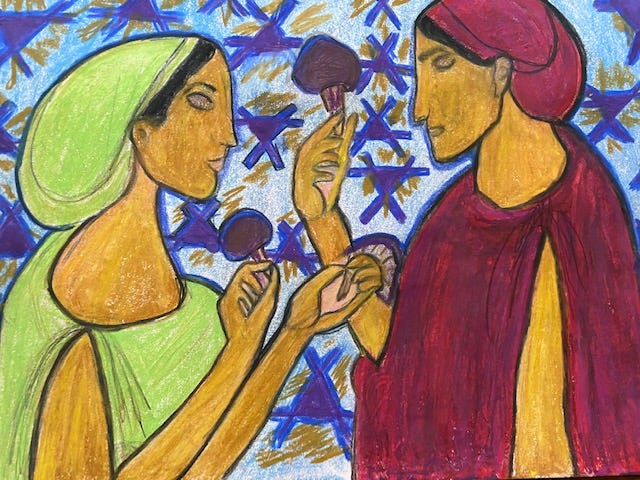
I fell into a research hole that lasted years. There were three levels of initiation, the highest being epopteia, those who see. What did they see (or understand) that removed the fear of death, because as near as I can tell, the fear of death runs every aspect of our lives, from the structure of our individual ego to our institutions like our religions and courts, our schools, and our politics. Time machine, please! I want that initiation. Our fear of death bleeds into everything. Who wouldn’t want to be free of that?

I come from New England Puritans on my father’s side, and that was a fear-of-death cult if there ever was one. Were you asked, in eleventh-grade American Lit, to read an excerpt from Sinners in the Hands of an Angry God? My kids read it. Those people went to church for at least six hours on a Sunday to be berated by clergy telling them in agonizing detail how God holds you over the fiery pit of Hell by a spider's thread and surely will drop you, because you are despicable to him. You are disgusting to God, who abhors you. The sermon, delivered in a deadpan tone, caused people to writhe and wail in church.
Imagine the fear of death that dogma produces! And then imagine the way it plays out in everyday life, as your belief system must.
That bit was presented in the textbook I taught from as an odd window into the Puritans’ psychological makeup. Except that the part overlooked was that it led to the judicial murder of at least 11 people in Hartford, and 40 years later, at least 25 people in Salem. Poor Hysteria. Blamed for so much for so long. Why were they hysterical? Hmmm. Could it have been their fucking male-dominating, god fearing religion that claimed dominion over the earth, native peoples, and women? And if you look around, you can see how the descendants of Puritans use the fear of death to gain wealth and power - still. But does this demonizing still lead to judicial murder, though? Yes. Yes, it does.
In researching my novel, I discovered that there was a place in absolutely misogynistic ancient Greece where women had power. Where they were allowed on stage: Eleusis. There was a place where women earned an independent income (lots of it), where they had children unfettered by marriage, and kept them - Eleusis.
How does a culture with a misogyny so thick that wives were sequestered in separate parts of the house also contain a place where Women’s Mysteries were so venerated as to be protected by law? Another women’s mystery, the Thesmophoria was too. By law, a man could not prevent his wife from attending. I wondered. Was there a time before the hatred of all things female was institutionalized entirely?
And the answers started flooding in. No systemic change of this magnitude could happen overnight. Impossible. Without violence, cultures change at a glacial rate because change is resisted. People do not willingly give up their gods, though they may happily put new gods beside the old ones. Wasn’t it possible that the old ways and the new ways existed side by side - for millennia? Not only possible, but wasn’t it likely? And wasn’t the violent end to the Women’s Mysteries at Eleusis an inflection point in the march of monotheistic patriarchal dominance that we still live in today? Hmmm.

Honestly, when male academics try to claim that we have patriarchy now because we’ve always had it, or because it’s just a superior system, I see just how effective burning all those libraries was. If I asked my brighter high school student how old Western culture is, they’d blink and say 2k years. If I asked the less bright ones how old the world is, I’d get the same answer. It’s when the calendar starts. (Calendars are a whole separate post)
I call myself a humanist now, because the word feminist carries such freight, but I haven’t changed except in one way. I’ve finally realized how horrible this culture of domination is for almost all men, too. They are suffering hard under a system that controls them by denying them the full range of human intimacy, where their idea of self is manipulated by shame because the last thing you want to be is a pussy. And, as a veteran high school teacher, I can tell you the most depressed people I see are adolescent boys. In every class, I had boys so depressed, high, or both that they could not pick their foreheads up from their desks. And now, another one has gone and shot up yet another school. Thoughts and prayers. Which is my version of Vonnegut’s “And so it goes.” Fear of death and fascination with it are poles on the same spectrum.
So, how did we fall into this mess where we worship death rather than life? Hmmm. Let me tell you a story.
Please feel free to comment. I love it when you do.

I will never stop calling myself a feminist. Do I have compassion for men, and the hand they've been dealt? No and maybe yes, the tiniest bit. We've all been given brains and hearts and hopefully a conscience to go with. Discernment is a tool available to all of us. So for me, yes, depressed teenage boys is a very real thing, I witnessed it growing up. But there were a lot of depressed teenage girls, too. And I can almost guarantee that their parents were doing a damn good job reinforcing the "roles" we'd all been assigned for far too long. I'm angry about the oppressive culture I grew up in. I'm angry that we're going backward with such alarming speed.
I'm angry that men can't seem to disengage from their love affair with violence and guns, to the point where little children are repeatedly slaughtered in spaces that are supposed to be safe, and no one does a damned thing about it except dig their heels in even more. It's got to stop.
Is a gun just an extension of a penis to a man's psyche? Don't know, but I'd fathom a guess. Goddess forbid we're spared the rod, once and for all. I can't wait to read the story...I wish I could be more open-hearted about what men have suffered, but that one's really tough for me. Kind of the most sarcastic boo-hoo. Will we ever be able to teach men that being tender, soft, and loving is totally acceptable? Why do we have teach them? xo
Susan, your essay stirred something deep. I often think about how those three arrogant Greek philosophers—Plato, Aristotle, Socrates—became the first to codify patriarchy into words. They spun unproven hypotheses with such self-confidence that entire civilizations bowed to their “truths.” And once the Christian religion layered itself on top, the cement hardened.
Yet before that, there were women who reigned—Cleopatra standing eye to eye with Caesar and Augustus, Nefertiti and Hatshepsut in Egypt, Semiramis and Nitocris in Babylonia, Olympias shaping Alexander’s path, Artemisia commanding fleets. Patriarchy was not inevitable; it was enforced.
Your return to Eleusis and Newgrange makes me remember how much has been erased—and how much still lingers, waiting to be recalled.