

Befriending Death
Embracing my Deepest Fear

Last week, I finished what should have been the final version of my novel. But something nagged. The main character can speak with the dead, but her gift only appeared sporadically when it should have been woven throughout the narrative. Her gift needed to become the lynch pin of the plot, or it needed to go. I wondered, what if Death were a character, her inner ally, a dream figure, and ultimately her friend? Why not jump to the crux of the human dilemma?
I closed my eyes, dropping deeper and deeper. Breathing in and out through the chest: Open my compassion. Then, in and out through my throat: open my voice. Then, the forehead: Open my imagination. Finally, the top of my head: open my connection to the all-that-is. I’d never dropped in like that before. I felt so still, so quiet, so broadly in the room rather than confined by my skin suit.
I asked, How do we befriend death?
A meditation on death is rather terrifying. I saw my narcissistic fear that someone I loved might die. That’d teach you. Next up, the fear that I was planting the seed of some future illness that would haul me through the death and rebirth narrative that ends in gratitude for a new worldview. Then, the fear of a near-death accident. Or any number of ways a prayer like that could be answered. However, I trust my inner wisdom, and I am willing to feel the fear. But because experience is the best teacher, I did ask for gentleness - as you do.
Then, I went for a walk in the woods, repeating my question to the rhythm of my steps. How do we befriend death?
It’s as though time stops. My vision pinpoints, and the ground before me opens from my peripheral vision in expanding waves of parentheses, moving outward in space. My gaze is inward, both seeing and unseeing. Still and silent, listening. Sometimes I hear words, sometimes I see scenes play out, but this time the awareness given me was an inner smile that curled my hair. I thought: “Everything is about befriending death.” Then I saw about 12 ways that would work in the plot. When the moment passed, I clapped my hand over my mouth. I could have shouted: “I found the key!”

The next day, I took my car to get it smog-checked. I’ve lived in my neighborhood for over 25 years, and I’ve only ever gone to the place down the street. It’s owned by an Iranian man, who's older than I am, so that’s pretty old. I’ve always loved this guy. He’s sweet and gentle, and he talks about how much he loved his wife, who is gone now, and how proud he is of his daughter, who is a lawyer. Every time I go there, he offers to buy my car in a flirty way that never crosses the line into cringy.
When I pulled up, he was sitting alone in the bay, eating his lunch. He waved me in anyway, and another older white woman pulled up behind me. When I got out of my car, she rolled down her window and, apropos of nothing, said, “It’s terrible what they’re doing to Elon.”
I whipped my head back, Elon? My brain sputtered, and a wave of indignation jangled outward from my chest and radiated down my arms like a heart attack. “Elon?”
“Yes,” she said, “the way they’re attacking his dealerships and burning his cars.”
I scoffed. “The Marines and the National Guard are mobilized downtown against the wishes of the mayor and the governor right now (we live in LA), and you’re worried about a few dollars of damage done to a billionaire? Are you aware that they marched through McArthur Park this weekend, pointing rifles at children?”
“I’m a Republican, but I didn’t vote for Trump,” she said.
“Not voting is still voting,” I shot back.
Without turning his head toward me, the Iranian man waved me over to the console that communicates with the DMV for what appeared to be a private consultation. I worried that my car didn’t pass. He never looked at me. When he didn’t speak, I noticed the gentleness that surrounded him and stopped arguing. He regulated me into alignment with his peace. Then, I was myself again, but my body still vibrated with an anger hangover. “I’m so sorry,” I said to him. He slid the paperwork to me, and when he gave me the pen, he paused with his rough hand over mine. The gesture brought tears to my eyes. He still never looked up. Speaking toward the ground, I let my hair fall over my face. “Thank you,” I said. Before I left, I wished the woman a good day, and meant it.

The day after that, I went to lunch with two teacher friends. About 20 years ago, we worked at the same school and have kept in touch by having lunch at least once a summer. These are the kinds of friends that, no matter how long it’s been, we fall right back into the previous conversation without missing a beat. One of the friends I see more often. We talk about healing. She comes from a 12-Step perspective, and I come from spiritual communities and silent retreats, different dialects of the same language. The conversation dove deep as we drove to California Pizza Kitchen.
When our friend arrived, she seemed agitated.“I hate the union,” she said with force and venom.
I was taken aback. I thought we all loved UTLA. I mean, they aren’t perfect, but live better; work union, right?
A silent conversation passed between my friends. Then one nodded.“They hate Jews,” she explained. She opened an email on her phone and thrust it across the table. It listed bullet points from the recent National Education Association vote to stop using the ADL-created curriculum and materials, as well as the conversations as reported by someone who had been inside the room when the resolution passed. “Anti-semitism masked as activism,” the writer summed up.
“I’m so sorry,” I said, handing the phone back.
“I can’t even get an Uber if I use my real last name,” my friend said. “They won’t drop off or pick up at a temple.”
The other friend nodded slowly. “Two households of my family have sold everything and moved to Israel since October 7th,” she said.
“I went to my first rally on October 8th. As much as I love my husband, if he disagreed with me on Israel’s right to exist, I couldn’t live with him.”
Please help me,” I thought, turning my gaze inward. A vast space opened. It was filled with love for my friends, who sat before me, jangling to the tune of a centuries-long existential terror. Over the course of three hours, I never said anything that didn’t come from stillness, though some of what they believed was disinformation, easily debunked.
Instead, I said things like, 'Do you think you can trust what the IDF says?' Or, ‘How do you respond when people say…’ ‘What do you think about…’ Every time I felt the urge to jump to my arguments, I heard my inner voice say, Softly, softly. Listen, listen. It was discipline, but it wasn’t difficult. It held me.
She sighed. “I couldn’t vote in the last election, not for president. I left that part blank.”
“I get that,” I said.
The whole time I watched the mechanism of terror, I had fallen prey to just the day before - the way it felt, the way it worked, specifically as it selected evidence and made its case for war. I let the silence choose my words. I said I was a feminist and didn’t trust any government run by men who were willing to kill people or sacrifice their own citizens in order to win. That included Hamas, Israel, and the United States. “Especially suspect,” I said, “are those willing to sacrifice innocents.”
“They are not innocent.”
“They are not all Hamas.”
“They voted for them.”
“Surely, not all of them. Not even Russia votes 100%.
She looked up the actual number. “44.45%.”
“That’s Trump’s approval rating right now,” I said. “They are building labor camps.”
There was a deep silence after that. At one point, I said, “I love you. That’s the only thing I know for sure.”
While it was happening, I watched the mechanism by which our fear of death selects the evidence we accept. It makes our arguments and decisions. Politicians manipulate us, thinking they are masters of the fear of death they stoke, even as it manipulates them in return. No one can ever win when this mechanism is in charge.
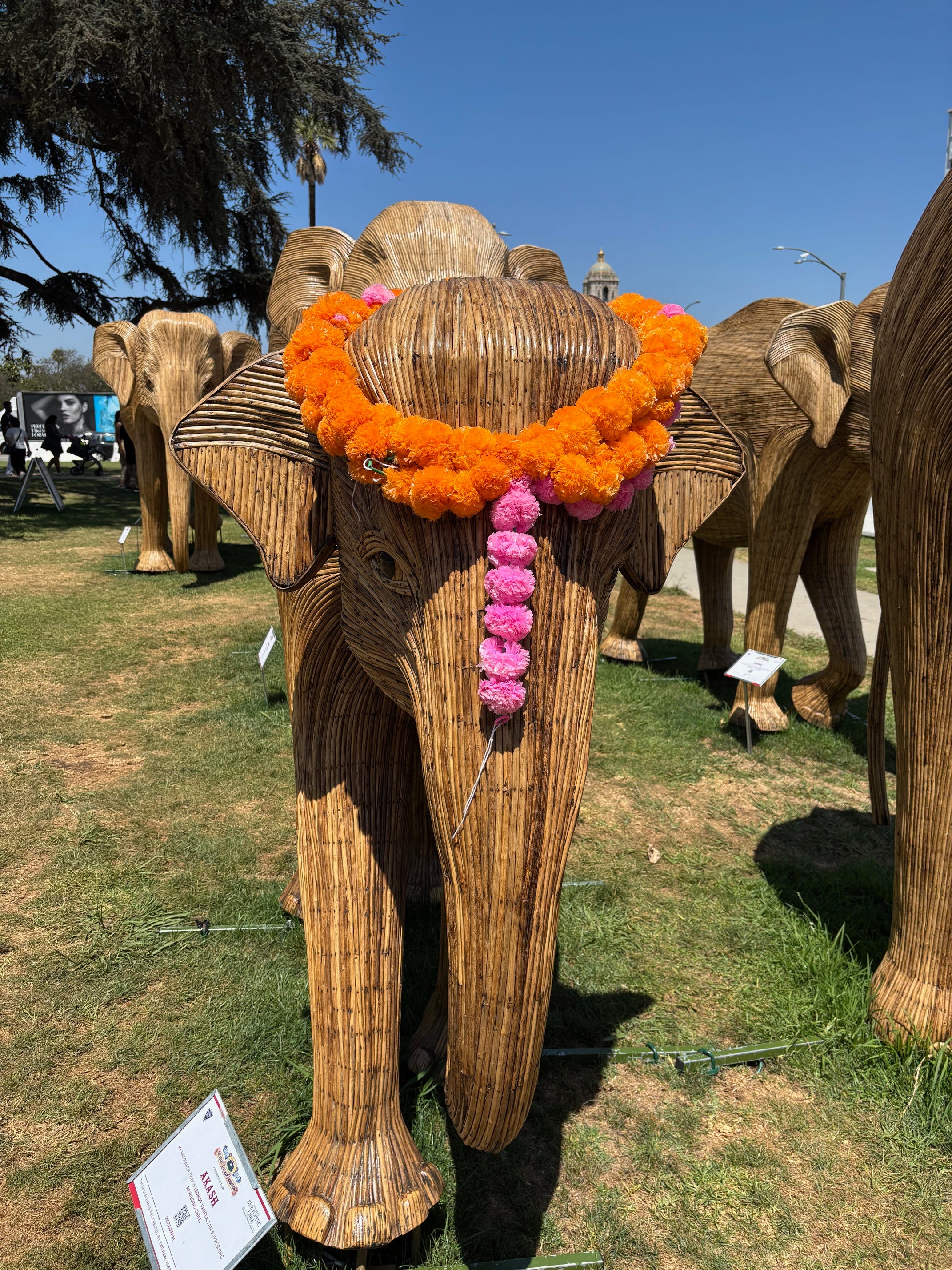
Then, with nothing resolved, we girlfriends walked to the park, linked arm in arm, leaning into each other with affection, to see the visiting herd of bamboo elephants. I especially love this physicality because I never had friends like that when I was growing up. They lean faces against shoulders, squeeze forearms, and hold hands.

Then, the day after that, still buzzing with the whole tense conversation and my otherworldly stillness during it, an image arose. Once, a lifetime ago in the early 90s, I was a teacher of A Course in Miracles. The memory of a man visiting our intrepid group bloomed around me. He was remarkably still, sucked us all into a silence vortex, and in his presence, we had the best meeting we’d ever had. I approached him after and asked him what he thought, looking, of course, for praise. He didn’t answer for a long time. Then, he said, “You have a very good intellectual understanding of the Course.” I was wounded, which is why that moment has stuck with me for decades.
Attached to this memory, the words surfaced: I’m never upset for the reason I think. As I reviewed this memory, I saw how I had controlled everything. I was the teacher. It was my group. I’m sure I commented after every participant, tweaking their perceptions rather than resting in presence. Issues of control are another iteration of my fear of death.
I used to become upset with the author of ACIM. I’ve thrown that book more than once. Then tell me the reason I’m upset, I used to think. What’s so hard about that? Is it a state secret?
Here’s what I think now. When I’m upset, it’s because I know I have to die. It’s coming and I can’t control it. Every argument, every obsessive thought is about that. This mechanism, this fear, is what my ego is, its structure. Fear of death is the mechanism that holds it together, and the need to prevail is what keeps it so solid as a force in the world.
That’s the best reason to undertake befriending death. Maybe if I befriended her, I wouldn’t be so quick to jump out of love and into fear. Why wait until meeting her is the only thing left?
This is SO brilliant. By George, I think you've got it! The more I let go of my fear of death, the more peaceful and calm I become. I'm able to open my heart more, hear more (especially from people I disagree with), and the more grounded I become in my understanding that I can only deal with things as they present themselves, one day, one moment, at a time. When I begin to perseverate about the future it's a message that I need to return to grace and bring myself back to the present in order to balance myself. It's a message that fear is trying to take over. I'm grateful for hearing that message. We all die. xo
So profound. This adds so much to your work.