

Naked, Exposed, Willing to Die
Inanna’s Seventh Gate

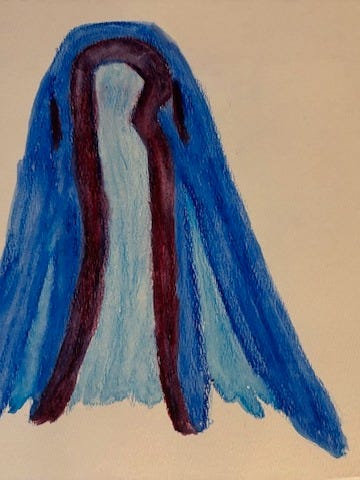
In ancient Sumerian and Mesopotamian mythology, Inanna, Queen of Heaven and Earth, descends through the seven gates to the underworld in an archetypal pattern of death and rebirth—a pattern I believe our culture is experiencing now. This post is part nine of a multi-part series, though each part is a separate subject and stands alone. All previous posts are available at Modern Mythology.
When she entered the seventh gate,
From her body, the royal robe was removed.
Inanna asked: “What is this?”
She was told:
“Quiet Inanna, the ways of the underworld are perfect.
They may not be questioned.”
Naked and bowed low, Inanna entered the throne room.
Wolkstein and Kramer
The seventh gate exposes the root and core, the foundation upon which the whole egoic hall of mirrors is built. The royal robe covers the naked truth. When removed, the simple animal, without the clothing of culture, sees that death, no longer denyable, is the very next thing. Sit with dying people. I can’t recommend this strongly enough. You will see how little matters in the end - how this journey was only - ever - about love and the courage to express it in all its forms: physical, emotional, and spiritual.
The journey through the gates is a descent through an ancient passage tomb; the destination is the womb of the world. Death is the mirror image of birth, a returning through the birth canal in the opposite direction—toward the womb, where a pregnant Ereskigal’s archetypal function is to receive all the dead and give birth to the world anew. Each gate squeezes so the gatekeeper can remove an article of power, and each contraction propels her to the next contraction. At the last gate, Inanna must know death is next. The opening to the seventh gate is so low that, naked, exposed, and willing to die, Inanna must crawl.
I reached this gate shortly after Jim, one of the two elders Phyllis and I provided hospice care for, died of cancer. Before he got too sick, Jim signed a contract with a mega-church, giving them the house and estate if they promised to continue to care for his wife Jean, an Alzheimer’s patient, in their home after he was gone - no institutions. Jean’s body was healthy; she would live years longer than Jim. But the couple had no family. So, within a week, Jean was in a nursing home, Phyllis had a new job in Lone Pine, and a lockbox appeared on the front door. The church’s lawyer told me I could stay until the house sold if I kept it looking nice for showings. I began another frantic search for a job and a place to live.
But my work was drying up. The inpatient adolescent psychiatric hospitals where I worked were going out of business because insurance companies no longer covered inpatient stays. I was lucky to find per diem work two days a week. I could not scrape together a first, last, and security deposit. I needed a room somewhere, and I found one.
But I still wasn't safe. Again, my plans fell through at the last minute, and with less than 24 hours left, I had nowhere to live. Terrified is too small a word for what I was feeling. Didn’t twice make a pattern? That evening, I attended Phyllis’s old meeting of A Course In Miracles because if anyone needed a miracle, it was me.
I listened to the lesson, my heart fluttering against my ribcage, my eyes wide. In closing, the minister who led the meeting asked if anyone needed prayer. Everyone turned to look at me. Was it that obvious? I stuttered, stammered, stopped, and started, but finally, I told them I would be homeless in the morning. I closed my eyes to keep them from coming at me with a sympathy that would break me.
The minister launched herself into prayer. She was a tough love sort, and I appreciated that. When the meeting closed, a bright redhead with a slight southern accent hugged me. “You can stay with me, Honey,” she said.
I pulled back to look at her. We’d just met that night. “Really?”
She nodded. “It’s only a couch, but it’s better than your car.”
Debra, my beautiful new friend, was a secretary who lived with her teenage daughter in a one-bedroom apartment. The following day, she left me phone numbers for temp agencies and went to work. Her daughter left for high school. I’d never done secretarial work before, but I made several appointments for intakes later in the week. Then, I sat on the couch looking at Debra’s bookshelf, stunned by all that had happened. One red spine practically glowed: Bradshaw on the Family. I leafed through it, then read The Overview and The Sickness of Soul Shame.
He was writing about me. I’d spent the last year and a half on the brink of homelessness. I’d grown up in a house full of alcoholism and violence. All my boyfriends turned into the father with a thousand faces, and every home I landed in contained a battered wife. I lay on the couch with the book open against my chest. I closed my eyes and prayed: I’m willing to heal my shame. I thought shame would lift from me like a cartoon soul leaving a body. I expected angels to sing or to feel my body shake apart like the Enterprise entering warp speed. Nothing happened.
I’ll take a bath, I thought. I stepped into the water, leaned back, and closed my eyes. A waking dream, as vivid as any night dream, opened inside the theater of my mind. I was inside my four-year-old body, sitting in the bathtub of my childhood home. My father was soaping between my legs. Then I was standing by the sink, watching as he ejaculated into the toilet. The whole thing took 10 or 15 seconds.
I shattered. I sobbed and howled until the water was cold, and still, I couldn’t get up. I was trapped in a wailing body - a place I never wanted to be. Ordinarily, I’d pop out, be somewhere above myself looking down. Not this time. And I hated it. After what must have been hours, the questions started. What if I never stopped crying? How would I work? Was that a dream? Because that was not a memory. I had no memories from being that age. Sexual impropriety had flourished in the house that shame built. Why hadn’t I seen any of the actual moments? There were plenty to choose from. Had that happened and I’d forgotten it? Who was I if I didn’t hold my history? Was I crazy? Ultimately, it didn’t matter if what I saw was factual or symbolic. The shattering was actual.
Hours later, shivering and dripping, I wrapped a towel around me and called a man I’d met only once. He was a big black man who channeled a disembodied spirit with a Scottish accent named something Gaelic I can’t remember now. Joseph was kind, through and through. He came right over, even though I told him I had no money. In meditation, Joseph took me right back into the dream. “If you look down at your father’s feet,” he said, “you’ll see two money bags. These are bags of shame. Pick them up and hand them to your father. He has to take them; they belong to him. Then run - out of the house and down the street. Don’t look back.”
Though this happened thirty years ago, I can still measure my life from before and after that day.
Only now, so much later, I wonder: To whom should my father hand his bags of shame? His father? And then what? Whose is the original sin? Is all this some mythical Eve’s fault because she disobeyed some petty patriarchal god incapable of compassion? Is all this male violence a woman’s fault? Pretty convenient, that.
Because I still love my father, I think about what wounded him. He was acculturated to believe that strong men dominate and weak men are losers, that he couldn’t have tender feelings, and if he did, he would be womanish, shamed, and humiliated. What shamed him?
His mother told him that when he was a colicky baby, she caught his father holding a pillow over his face. That’s why she threw that bum out. I raised a son. I can’t imagine any good reason why she would tell him that.
Then, his stepfather routinely humiliated him to teach him how to be a man and to dominate him - as a competition called: Who is the Man of the House? My father sobbed when he told my mother how he lost his childhood dog, a German Shepherd he adored. His stepdad had secretly trained the dog to come to him when called. Then, as a contest, he sat the dog between them in a field. They both called. I bet the dog knew who had the cookies, but his stepdad told him he was better at training obedience - which dogs naturally crave. My father’s dog belonged to the stepdad now because he gave it discipline. In the tricks of being a real man, the stepdad won.
If my father didn’t drink, none of these stories would have come out, but because he drank, they never healed. He spent the last two years of his life so depressed that he stopped working and lied about it through falsified sales call reports. My mother went back to work and got a degree simultaneously. I saw the shame he felt over that. He was terrified he’d lose her to a better man. “You’re gonna leave me. I just know it,” he howled. Then he died under suicidally suspicious circumstances. Patriarchal culture is so hard on men.
Our world is terrifying. Our institutions, our religions, our courts, and our social and political systems are designed to assuage our fear of death. We live in a world where animals eat one another and human beings start one devastating war or genocide after another. Even our most potent addictions can’t numb that. The amassing of great wealth, the physical and political violence we are seeing now, the hard shift to the right, and the attraction to abusive, narcissistic, strong men are a re-imposition of monotheistic patriarchal control over all of us - women and men - because we are are terrified that love is weak, that compassion is stupid, and that in a dog-eat-dog world, it’s every man for himself.
Our royal robes are off now. We are exposed in all our nakedness, especially in American culture. Our weakness, corruption, and ineptitude are exposed. The purpose of monotheistic patriarchal control is exposed, and it gets uglier every day. How do they dominate? Cruelty. How do they amass wealth? Cruelty. How do they silence dissent? Cruelty is the point. We are the cruelty culture.
But I know what happens next in the old stories. There is nothing new under the sun. These stories are archetypal. These petty men play roles they don’t comprehend. Whether or not I live to see it, the ego doesn’t win. But I believe I will see it, and relatively soon, too, though the arcs of cultures can be long. When we arrive at the threshold of the last gate, naked and bowed low, we will crawl through it. Something enormous, exponentially more potent than their manipulative graft, something enraged, some archetypal dark feminine force, a god complex, will rise from her throne and give us all a death-dealing slap.
Thanks - I found this very moving. The story of Ershkigal and Ianna is also one of my favourites- so much to say about descending and women’s experience. Like you I work with the dying- do you still? Teaches me so much about living.
Wow. There’s so much here to think about. This is one of those pieces that sticks with you.